AI & human adaptation
The Intelligence Gap
When AI advances faster than people can adapt
The intelligence gap is the widening distance between what AI can do and how quickly people can learn, adapt and make use of it. For Steve Bolton, understanding that difference in pace is one of the central challenges of the Intelligence Age.
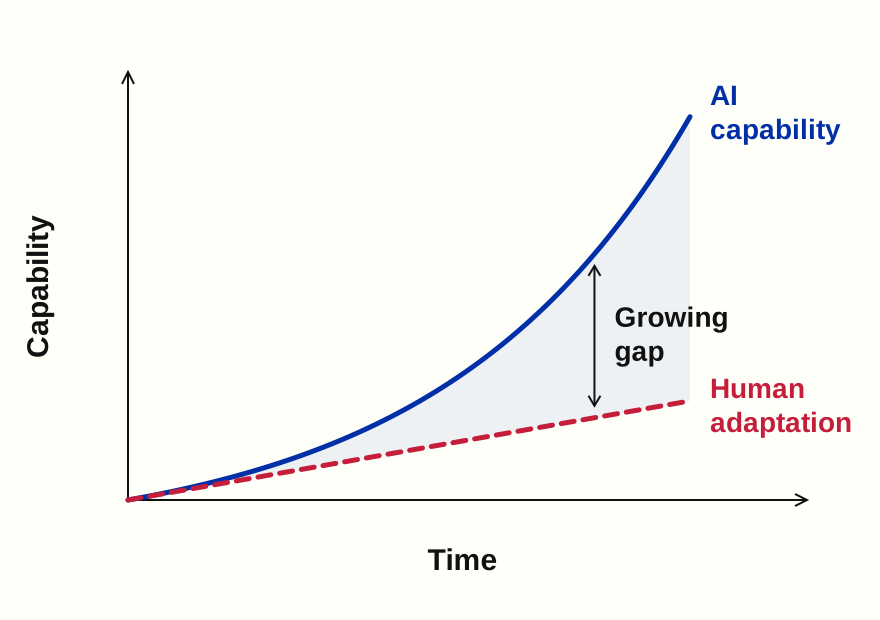
His argument starts with two trajectories. AI capability can advance on an exponential curve, with progress building on earlier progress. Human learning and the ability to change are slower processes. When technology advances faster than people and organisations can adapt, the distance between the two grows. That creates both challenges and opportunities.
Two speeds of change
An exponential curve becomes steeper over time. The increases get larger as they build on what came before. In the illustration above, AI capability follows that accelerating path, while human adaptation rises along a much gentler line.
People can become more capable, but developing understanding, confidence and new habits takes practice. A business also has to change how work is organised, how decisions are made and how responsibilities are shared. Making a new tool available is only one part of that process.
Steve’s concern is the growing distance between technological possibility and the capability to use it well. A new system may offer more than an organisation is ready to absorb. If the response remains occasional training followed by a return to familiar routines, the gap can continue to widen.
The challenges of a widening gap
For individuals, the pressure to keep up can become exhausting. Each new capability raises another question about what to learn, what to change and which skills will remain useful. Without a clear purpose, trying everything can leave little time to develop a practice that lasts.
For businesses, the challenge includes uneven adoption. Some people may move quickly while others lack time, support or confidence. Workflows can become fragmented, and teams may struggle to agree when AI should contribute or who should review its work.
There is also a risk of confusing access with readiness. A capable system does not automatically give its users the knowledge to recognise its limits, judge its outputs or decide where it belongs. As AI takes on more substantial work, those human responsibilities need greater attention.
The opportunities within the gap
The gap also represents capability that people have yet to put to useful work. For a business, the opportunity may be a better way to examine a decision, reduce repetitive administration or make specialist knowledge easier to understand.
AI can contribute to adaptation itself. Used carefully, it can help someone explore an unfamiliar subject, ask questions without embarrassment, rehearse a difficult conversation or examine a problem from several perspectives. Its contribution becomes valuable when the person develops understanding they can use and explain.
The opportunity is therefore broader than producing more output. It includes helping people learn more effectively, improving the quality of their decisions and giving them more capacity for work that matters.
Making adaptation a daily practice
Steve’s response is to connect learning with the work already in front of people. Start with a real question or task. Decide where AI could help, what context it needs and what remains a human responsibility. Try an approach, review the result and share what proves useful.
Repeated practice gives a team something concrete to build on. It can reveal where AI saves effort, where it introduces new problems and where a different way of working is needed. Training becomes part of everyday improvement rather than a single event.
Bolt Method provides a structure for those choices through Human, Tools, Agents, Partners and Networks. The appropriate Way depends on the work. Progress includes knowing when to use AI, how to work with it and when to keep a task entirely with people.
Human progress remains the purpose
The goal is not for people to match a machine’s speed in every activity. It is to strengthen their ability to direct increasingly capable systems towards worthwhile ends.
The widening intelligence gap makes adaptation a continuing responsibility. Steve’s proposition is that people and businesses can respond deliberately: discover what works, put it into practice and share what they learn. The measure of progress is whether growing technological capability helps people lead more capable, fulfilling lives and make a positive difference.